Small spaces
Where a daybed actually works
A backless daybed is a single bed doing sofa work. The rooms that suit it, the bolster that makes it sittable, and the depths that matter.
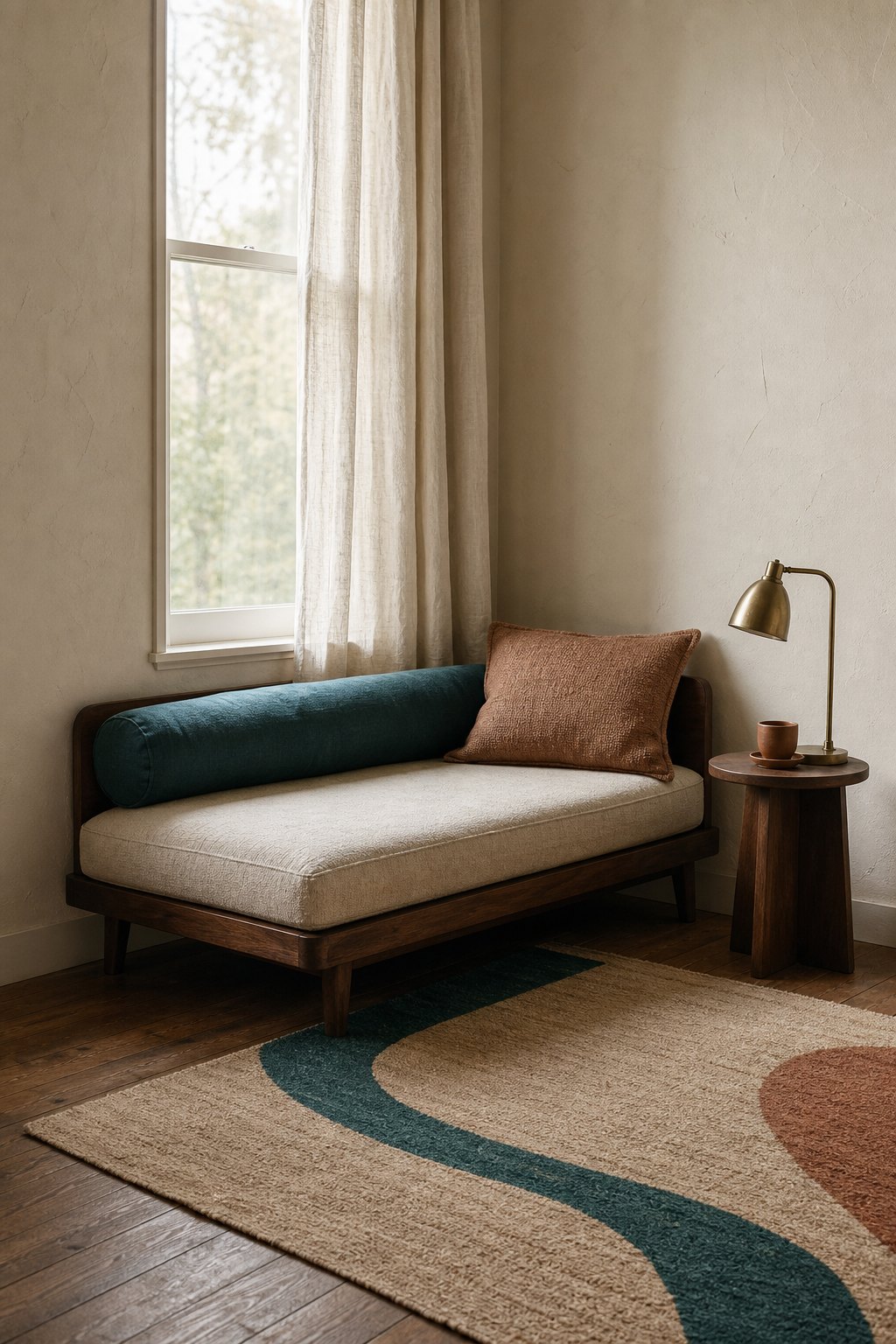
A daybed is a single mattress doing sofa work, and it earns its place exactly where a sofa fails — rooms where a sofa's back would build a wall. Backless, it is the lowest large piece of furniture you can own. That is the whole argument for it.
What is in this room
A backless daybed in dark-stained wood sits under a tall window, a slim rail running along the wall side and around one end, on tapered legs. The seat cushion is a cream textured weave. A teal bolster runs the full length against the wall; a single rust cushion in a coarse weave sits at the corner. To the right, a sculptural dark wood side table carries a brass task lamp with a domed shade and a small terracotta cup. Sheer linen curtains filter the light onto warm plaster walls and wide dark boards. Underfoot, a large flat-weave rug on a natural ground carries one broad teal curve and one rust arc — the bolster and cushion colours repeated once, at floor level, and nowhere else.
Sitting depth against sleeping depth
The tension in every daybed is dimensional. It is built around a single mattress, and single-mattress proportions are wrong for sitting.
- A standard single mattress is roughly 900mm deep and 1900mm long. A sofa seat is
550–600mm deep. Nobody sits comfortably at 900mm.
- The bolster is not decoration. A fat bolster against the wall takes 200–250mm out of
that depth and gives your back something to meet. Without it, the piece is a bench.
- Seat height should land near 450mm with the cushion compressed. Lower reads as bed.
- Keep 900mm of clear floor on the open side. A daybed that pinches a walkway below
that is an obstacle, not furniture.
Why backless changes the room
A sofa announces itself: its back stands 800–900mm off the floor and divides the room. A daybed stops at the bolster, and the eye travels over it — which is why it suits studios, wide landings, broad hallways and spare rooms. In a studio it is the sofa that becomes the guest bed without theatre. In a spare room it is a bed that stops the room reading as a bedroom.
A sofa back builds a wall. A daybed stops at the bolster, and the room stays whole.
Getting the look
Look for a frame in stained oak or walnut with a low rail on the wall side and at least one end — a rail-less platform sheds its cushions daily. If the piece will mostly be sat on, choose a firm seat over a soft mattress, and a bolster that runs the full length. The side table belongs at seat height with its own lamp, the same rule that governs a chaise. The rug should be large enough that the front legs land on it; a daybed hanging past the edge of a small rug looks marooned.
The photograph above is a rendered concept image, not a photograph of a real room. See our affiliate disclosure.