Dining room
The dining room is the right place for dark walls
Dining rooms live after dark, under one light. That is why grey-brown plaster works here and fails in the sitting room.
Most rooms are decorated for daylight and used in daylight. A dining room is used at eight in the evening, under one low light, by people sitting still and facing each other. That schedule changes the rules. It is the one room in the house where dark walls are not a risk but the obvious move.
What is in this room
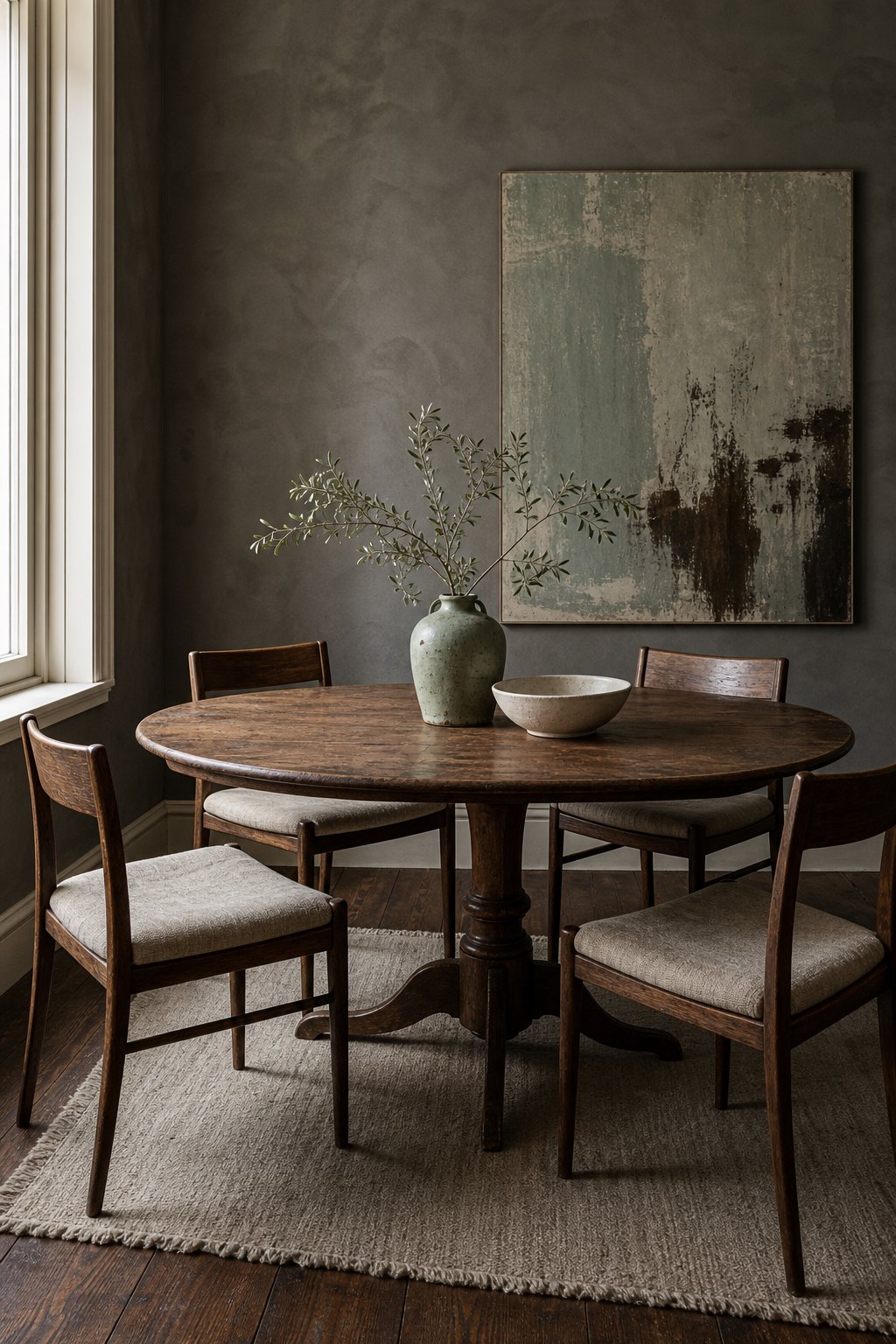
A round pedestal table in dark-stained wood, its base a turned column on splayed feet, standing on a fringed jute rug over near-black floorboards. Four chairs in the same deep brown surround it — open wood backs on slim frames, with seats upholstered in an oatmeal weave. The walls are plaster in a grey-brown somewhere between mushroom and slate, cloudy with trowel marks rather than flat. A large abstract canvas in sage, putty and rust hangs on the far wall. On the table, olive branches lean out of a speckled green-glazed jug beside a cream stoneware bowl. A tall window with an off-white frame rakes daylight across the plaster from the left.
Why this room can take it
First, timing. Dinner happens after dark for most of the year, and dark walls are at their best under artificial light — they stop competing and start receding. Second, enclosure. A sitting room is asked to feel airy; a dining room's whole job is to hold people at a table, so it is allowed to feel gathered. Third, light placement. With a pendant hung 750–850mm above the tabletop, light lands on food and faces while the walls fall away. No other room concentrates its light so completely in the middle.
Dark walls do not shrink a dining room. They dissolve its edges, and the table becomes the whole room.
Keeping it from going flat
The failure mode of a dark room is deadness, and this one avoids it three ways. The walls are plaster, not paint — limewash and clay finishes hold movement that flat emulsion cannot. The pale surfaces are all texture: jute underfoot, woven seat pads, matte stoneware. And the art carries the mid-tones, sage and putty against the grey-brown, so the wall is never one uninterrupted mass.
- Size the rug to extend 600mm beyond the table edge on all sides, so chairs stay
on it when pulled out.
- Keep 900mm of clear floor around the table for circulation.
- A 110–120cm round top seats four in comfort, six at a push — the case for round
is made in our sage dining room study.
Getting the look
Limewash or clay plaster in a grey-brown, two coats for the clouding; a dead-flat dark emulsion is the honest fallback. A pedestal table in dark-stained oak — four legs on a round top put a leg between someone's knees. Open-backed chairs — slatted or caned — keep the dark wood from massing; solid backs in this palette would read as a row of silhouettes. A jute or seagrass flat-weave, fringed or bound, sized to the table plus that 600mm margin. One green thing, cut, not potted.
The photograph above is a rendered concept image, not a photograph of a real room. See our affiliate disclosure.