Home office
A desk with drawers is an admission that you own things
The drawerless desk is a beautiful promise most people cannot keep. Here is the honest version, and a rule for each drawer.
We made the case for the drawerless desk in the cane-desk study and stand by it — for people who genuinely keep nothing. Most people are not those people. A working desk accumulates chargers, notebooks and a stapler nobody remembers buying. The honest response is not a tray on the surface. It is a pedestal of drawers, closed.
What is in this room
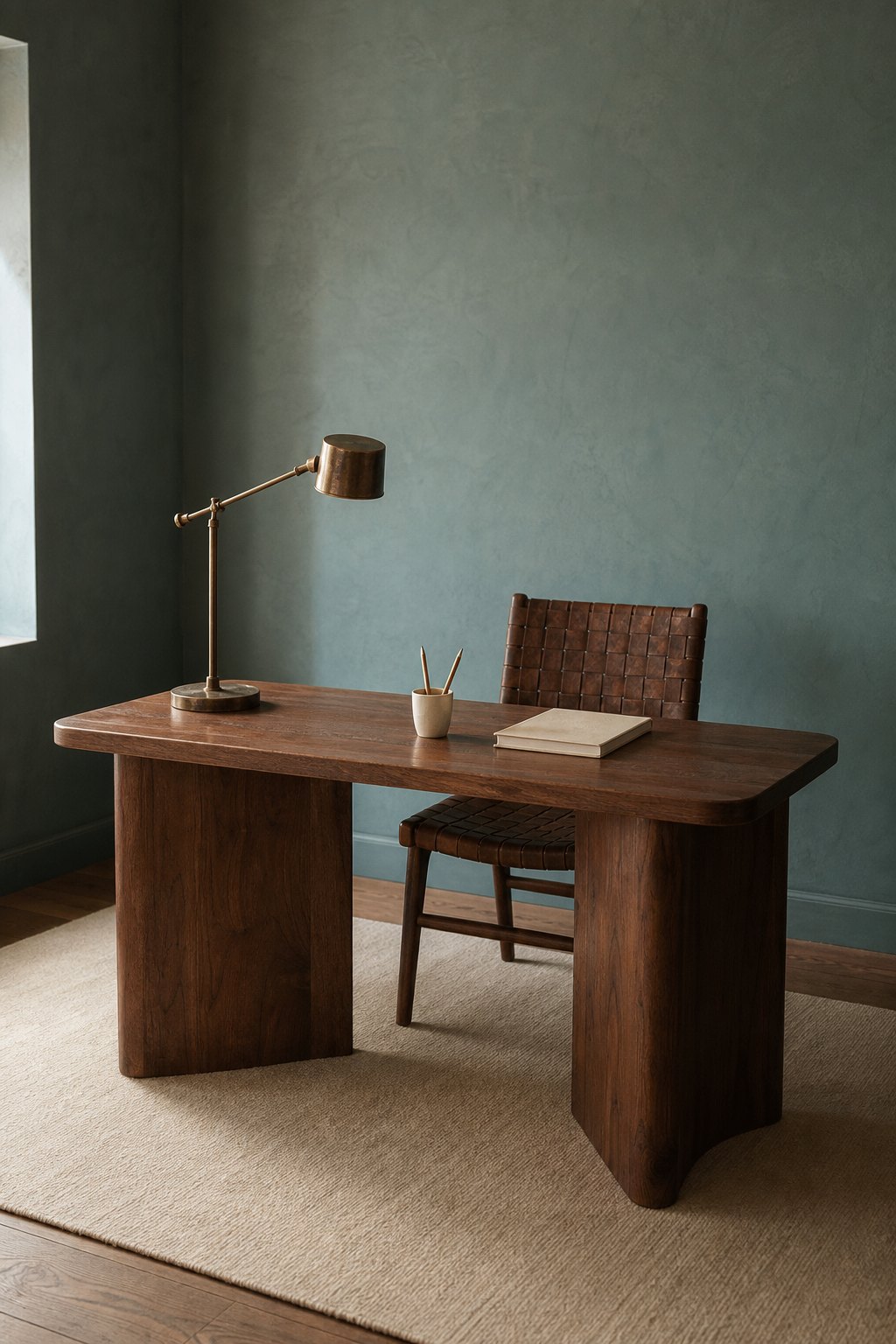
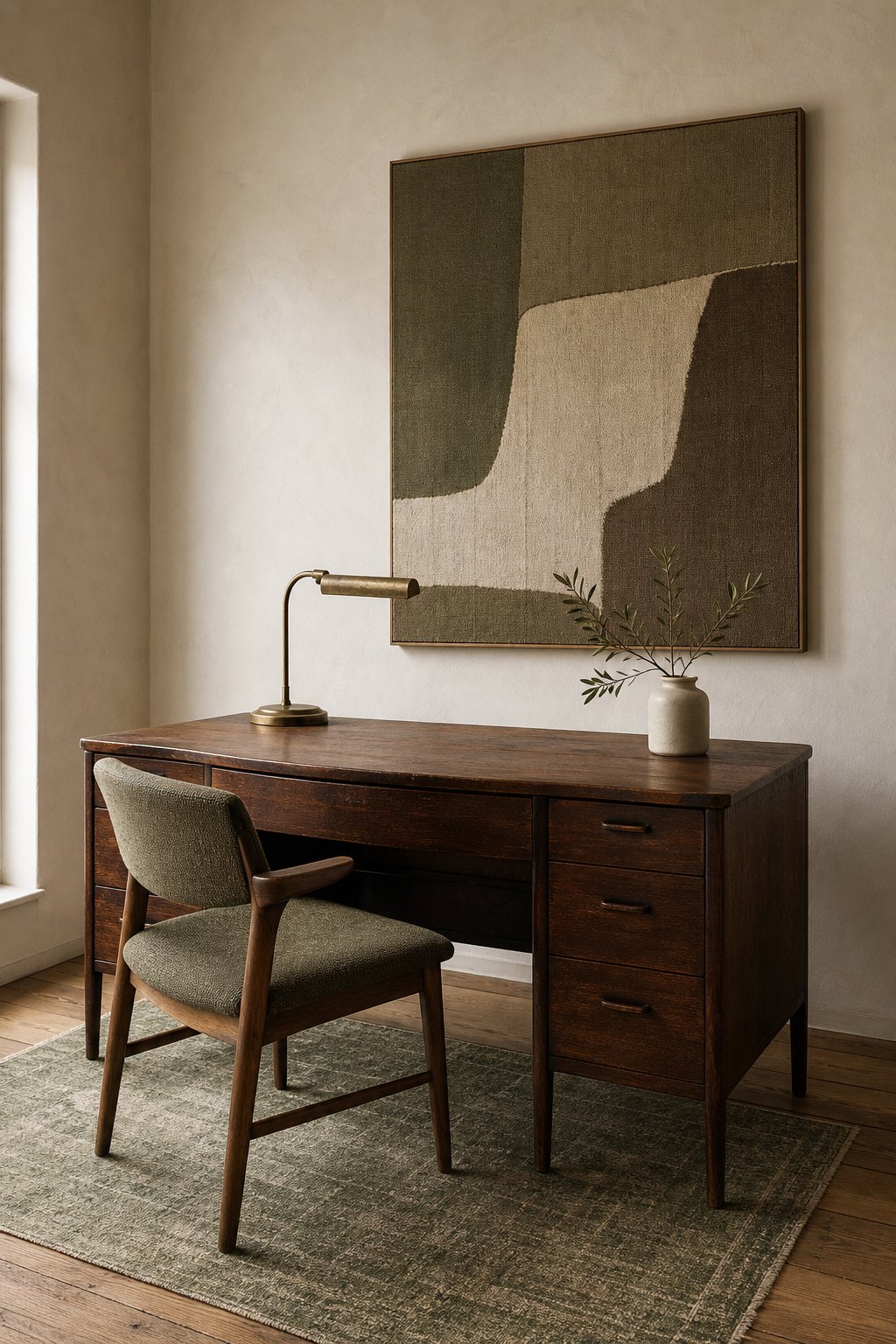
A mid-century desk in dark walnut-toned wood: twin pedestals of three drawers each, with slim timber pulls, an open kneehole between them, raised on slim legs so the piece never reads as a block. The chair matches the era — dark frame, open curved arms, seat and back in an olive-green textured weave. On the top, a brass lamp with an adjustable arm and a stoneware vase holding an olive branch. Above, one large square abstract in olive, umber and bone, thinly framed in timber. Underfoot, a washed sage-green rug over wide oak boards; plaster walls, and a window throwing soft light from the left.
A rule for each drawer
- Top drawer: things you touch daily. Pens, chargers, cables. If you open a lower
drawer every day, your drawers are assigned wrong.
- Middle drawer: paper in progress. Notebooks, stationery, the current project.
- Bottom drawer: files. A drawer with roughly 250mm of internal depth takes suspension
files upright. Shallower than that, papers stack flat and retrieval becomes archaeology.
A drawer is not clutter hidden. It is clutter given an address.
Depth, height, knees
- Desk height between 720mm and 760mm is the accepted range; this era usually sits at the
lower end, which suits writing more than typing.
- A 600mm-deep top is the working minimum; 700–750mm gives a monitor proper distance.
- The kneehole wants at least 600mm of clear width. A single pedestal makes this easy; a
double pedestal often does not.
- Check the chair's arms pass under the desk edge. If they collide, you will sit 100mm too
far away for the rest of your life.
Hanging art above a desk
Centre the piece on the desk, not on the wall. Keep the bottom edge 150–250mm above the desk top — close enough to read as one composition, high enough to clear the lamp. One large piece at half to three-quarters of the desk's width beats a cluster of small frames.
Getting the look
Look for walnut or dark-stained oak with recessed or turned wooden pulls rather than metal hardware. On vintage pieces, test that the drawers run — wooden runners wear, and a sticking drawer is a plane-and-wax repair, not a reason to walk away. Size the rug so the chair stays on it when pushed back — allow about 750mm of travel behind the desk edge.
The photograph above is a rendered concept image, not a photograph of a real room. See our affiliate disclosure.